What are sodium benzoate and potassium sorbate?
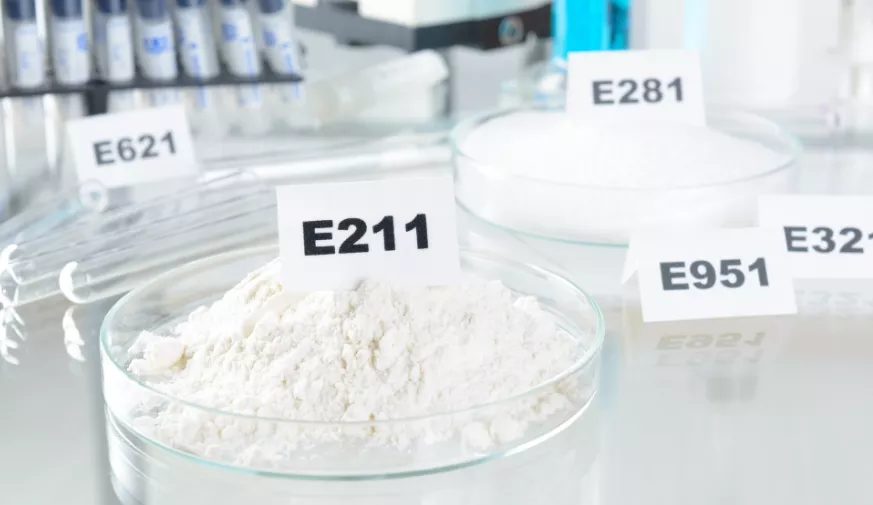
Sodium Benzoate (E211) and potassium sorbate (E202) are widely used food additives—preservatives that have been present on the market for decades. Although both are derived from compounds occurring in nature, their industrial forms are produced synthetically, ensuring consistent quality and microbiological purity.
Sodium benzoate is produced from benzoic acid, which can be found naturally in berries and honey, but for industrial applications it is manufactured under controlled conditions.
Potassium sorbate is the potassium salt of sorbic acid. The latter was first isolated from rowan berries, but in modern industrial applications only chemically synthesized sorbic acid is used.
Both raw materials are available in powder or granular form. They are readily soluble in water, which facilitates dosing and blending in production processes. Due to their effectiveness and versatility, they are used in the food industry worldwide.
The role of preservatives in maintaining food shelf life
Preservatives are a key tool in managing the shelf life of food products. Their role is straightforward—they inhibit the growth of bacteria, fungi, and molds that cause food spoilage and may pose health risks.
In practice, this delivers tangible benefits at every stage of the supply chain. Manufacturers gain longer shelf life, which supports better production planning and enables distribution to more distant markets. Retail chains reduce losses associated with returns and claims on expired goods. End consumers benefit from having more time to use the purchased products.
The result? Less food waste, more efficient logistics, and a real improvement in operational efficiency.

Scope of action: differences between sodium benzoate (E211) and potassium sorbate (E202)
Although both preservatives serve a similar function, they work under different conditions. Sodium benzoate is most effective in acidic products (pH below 4.5), which is why it is widely used in juices, carbonated beverages, ketchup, and pickled products. It is ineffective in neutral pH environments. Potassium sorbate is more versatile and active across a broader pH range. E202 performs better in neutral or mildly acidic products such as cheeses, bakery goods, and certain meat products.
Physical and organoleptic properties – differences and similarities
Beyond differences in their activity spectrum, both preservatives also differ in physical properties, which affect their practical application:
- Solubility: Potassium sorbate has significantly higher water solubility (1400 g/L) than sodium benzoate (556 g/L), which facilitates dosing and mixing in production processes.
- Flavor profile: Sodium benzoate may impart a noticeable sensory note, whereas potassium sorbate is characterized by a neutral taste and odor.
- Storage: Potassium sorbate requires careful storage due to moderate hygroscopicity, while sodium benzoate is more stable under warehouse conditions.
Synergistic effect – why does the food industry combine sodium benzoate and potassium sorbate?
Combining potassium sorbate with sodium benzoate enables a broader protection spectrum at lower concentrations of each preservative. This approach offers several practical advantages:
- Efficiency: together, they act on a broader range of spoilage organisms than when used individually.
- Lower concentrations: each preservative can be used at reduced levels, minimizing potential sensory effects (primarily taste).
- Cost: combining two relatively cost-effective raw materials can be more economical than relying on a single, higher-dose preservative.
- Reliability: the risk of insufficient performance from a single preservative is reduced, especially under varying storage conditions.
Sourcing both raw materials is a practical logistical solution for food manufacturers. The two preservatives are often used together in products with varying pH levels, such as sauces, beverages, dairy products, meat products, confectionery, and fruit and vegetable preserves.
Legal framework and permitted usage levels in the EU
Both sodium benzoate (E211) and potassium sorbate (E202) are approved food additives in the European Union. Their use is regulated by Regulation (EC) No 1333/2008, Regulation (EU) No 231/2012, and related implementing acts of the European Commission that update these provisions.
The acceptable daily intake (ADI) for sodium benzoate is 5 mg/kg of body weight per day. In recent years, changes have also been introduced for potassium sorbate – in October 2024, EU Regulation 2024/2597 reduced the ADI for E202 from 25 mg/kg of body weight to 3 mg/kg of body weight.
Regardless of the ADI, each food category has specific maximum permitted levels of preservatives, expressed in mg/kg or mg/L of product. These limits vary depending on the type of food—for example, carbonated beverages have different permitted concentrations than fruit preserves, cheeses, or meat products. Detailed limits for each food category are defined in Annex II to Regulation (EC) No 1333/2008. The presence of preservatives must be clearly declared on the label as E211 and E202.
Consumer perception: “E numbers on labels” vs safety
Product labels often raise consumer concerns due to the presence of E numbers. Both sodium benzoate and potassium sorbate have undergone rigorous safety assessments conducted by the European Food Safety Authority (EFSA). Despite changes to the ADI for potassium sorbate, this reflects a standard scientific review process aimed at updating risk assessment methods. It does not indicate that the preservative has become unsafe; rather, more precise analyses have allowed for a refined definition of its safety margin.
In the era of the clean label trend, manufacturers need to communicate clearly with consumers about the safety of these additives. For B2B buyers (food producers), this translates into a need for documentation confirming raw material safety, certifications, and regulatory compliance. All of this enables them to communicate on product labels that the formulation is safe and approved under applicable regulations.
Centro-chem – your food raw materials distributor
Proper selection of preservatives is not only a matter of technology, but also of a reliable supply chain and raw material quality.
For nearly three decades, Centro-chem has served as a distributor of food raw materials. The quality and safety of our services are confirmed by HACCP, ISO 9001, ISO 45001 certifications, as well as REACH compliance. We offer raw materials in bulk packaging, an individual approach, and fast order fulfillment. Rely on Centro-chem’s experience and choose a reliable partner for your business.