
- Chelating agents (sequestrants), together with surfactants, solvents, alkanolamines, and builders, form the foundation of household and industrial cleaning formulations.
- Their primary role is to bind calcium and magnesium ions, eliminating the negative effects of hard water and helping prevent scale and deposit formation.
- The most commonly used chelating agents include disodium EDTA (powder form, suitable for lower pH systems), tetrasodium EDTA (liquid form, typically used in alkaline formulations), HEDP (valued for stability under demanding process conditions), and Citric acid (commonly used in lower-pH and eco-oriented formulations).
- The selection of chelating agents depends on formulation pH, process temperature, and operating conditions — which is why multiple solutions are often combined within a single formulation in industrial practice.
- Chelating agents are available in both powder and liquid forms, while their transport and storage can typically be carried out under standard industrial conditions.
Why Are Chelating Agents Essential in Household Chemicals?
Calcium and magnesium ions naturally present in water reduce the effectiveness of detergents. To prevent this, household and industrial cleaning formulations use chelating agents, also known as sequestrants. These substances bind metal ions, eliminating the negative effects of water hardness.
The mechanism is based on the formation of stable complexes known as chelates, which reduce the reactivity of metal ions. As a result, active ingredients can perform more effectively, while the formulation itself remains stable. In addition, chelating agents help minimise deposit formation and improve the overall performance characteristics of household cleaning products.
Overview of Chelating Agents Used in Household Chemicals
The selection of a chelating agent depends on the product type and operating conditions. Detergent formulations often contain more than one type of sequestrant to ensure stable and consistent performance. Below is a brief overview of the most commonly used chelating agents from the perspective of a distributor supplying raw materials for household and industrial cleaning formulations.
Sodium EDTA Salts – Practical Forms of EDTA in Detergent Formulations
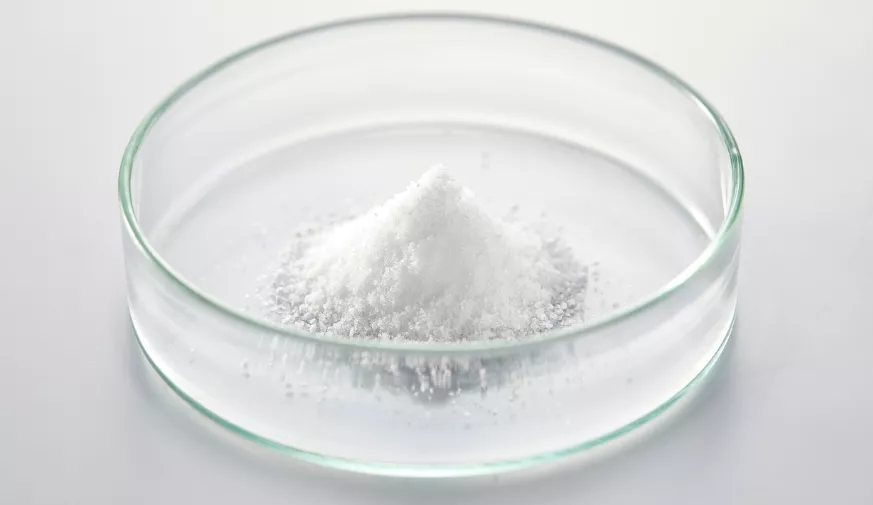
In household and industrial cleaning formulations, the most commonly used chelating agents are disodium EDTA and tetrasodium EDTA. These are practical forms of EDTA adapted for water-based formulations due to their good water solubility and ease of dosing.
However, their applications differ depending on formulation conditions. Disodium EDTA performs better in lower-pH systems, while tetrasodium EDTA is more effective in alkaline environments.
In practice, the differences between these two chelating agents are also visible at the operational level. Disodium EDTA is most commonly supplied as a powder or granulate, typically packed in 25 kg bags, making it convenient for storage and transport. Tetrasodium EDTA, on the other hand, is mainly available as an approximately 40% aqueous solution, which simplifies direct dosing and integration into production processes.
HEDP – Formulation Stability and Deposit Control
Alongside EDTA, HEDP, also known as etidronic acid, plays an important role in cleaning formulations. It performs a dual function — acting both as a scale inhibitor (through metal ion sequestration) and as a corrosion inhibitor, which gives it a significant advantage over standard chelating agents.
HEDP is characterised by high stability in the presence of chlorine and other oxidising agents, making it suitable for demanding formulations. It performs particularly well across a wide pH range and under elevated temperature conditions.
In practice, chelating agents of this type are used in applications where long-term performance stability is essential. Phosphonate-based sequestrants such as HEDP remain effective even under demanding operating conditions. As a result, detergents designed for dishwashers, bathroom cleaners, and water system applications can provide more durable performance and improved scale control.
Citric acid – a Natural Chelating Agent in Household Chemicals
In household and industrial cleaning products, environmentally conscious solutions are becoming increasingly important. In this context, Citric acid is gaining wider recognition. Compared to the synthetic chelating agents described above, it provides a milder chelating effect.
At the same time, citric acid performs both a sequestration and pH-regulating function. As an organic acid, it lowers the formulation pH and creates conditions that support deposit removal. Additional advantages include its natural antibacterial properties and its ability to neutralise unpleasant odours, making citric acid a particularly valuable ingredient in cleaning formulations.

Citric acid for Household Chemical Manufacturing
Over the past few years, one clear trend has come to dominate the detergent industry — sustainability. This shift is driven both by increasingly strict environmental regulations and by changing consumer expectations. Today’s customers are looking for products that combine high performance with biodegradability and simpler ingredient compositions.
This change is clearly visible in household and industrial cleaning formulations. As a result, established solutions such as disodium EDTA and HEDP are increasingly being complemented by ingredients with a more favourable environmental profile, such as Citric acid. In practice, this allows modern detergents to combine cleaning efficiency with evolving market and sustainability requirements.
FAQ: Chelating Agents – Frequently Asked Questions
In What Forms Are Chelating Agents Used in Household Chemicals Available?
Disodium EDTA is most commonly available in powder form. Tetrasodium EDTA and HEDP, on the other hand, are typically supplied as aqueous solutions. Citric acid is available both in powder form and as a liquid solution.
What Packaging Formats Are Used for Chelating Agents in Household Chemicals?
Solid-form chelating agents are most commonly supplied in 25 kg bags and big bags, while liquid chelating agents are typically packaged in 1000 L IBC containers, drums, and jerrycans.
How Are Chelating Agents Transported and Stored?
Transport opisanych powyżej chelatorów odbywa się w standardowych warunkach logistycznych. Kluczowe jest stosowanie szczelnych opakowań oraz ochrona produktu przed wilgocią, aby nie dopuścić do zbrylania w przypadku form sypkich.