Essence
A wide range of low- and zero-calorie sugar substitutes is available on the market, supporting the development of “zero” formulations. Manufacturers can choose from naturally derived sweeteners such as stevia, xylitol, and erythritol, as well as synthetic options like acesulfame K and sucralose. Sucralose is the sweetest—around 600 times sweeter than sugar—while erythritol offers a milder taste profile at approximately 60–70% of sugar’s sweetness.
From a sensory perspective, stevia is characterised by a slightly bitter note, acesulfame K by a metallic aftertaste, and xylitol by a neutral profile. For beverages, acesulfame K and sucralose perform best due to their high solubility and stability across a wide pH range, whereas in baked goods, stevia and sucralose are preferred for their heat stability.
Key technical parameters of sugar substitutes – overview
Growing consumer demand for “sugar-free” products creates specific technological challenges for food manufacturers. An incorrect choice of sweetener can lead to issues with solubility, loss of stability, or a compromised sensory profile. In practice, this is not only a matter of quality but also of cost—from production downtime to the need for reformulation.
The selection of a raw material also affects the ability to communicate nutritional benefits, such as reduced calorie content, no impact on blood glucose levels, or a lower risk associated with tooth decay. With increasing consumer expectations, sugar tax policies, and systems like Nutri-Score, the decision of which sweetener to use becomes a strategic factor in maintaining a competitive edge.
Key technical parameters of sugar substitutes – overview
When selecting a sweetener for production processes, key technical parameters play a critical role, as they directly impact formulation stability and the course of technological operations.
We have prepared a comparison of sweetening agents available in the portfolio of Centro-Chem. The overview includes stevia (E960), xylitol (E967), and erythritol (E968), as well as synthetic additives such as acesulfame K (E950) and sucralose (E955). These substances differ significantly in sweetness intensity—from levels comparable to sucrose to high-intensity sweeteners that are up to 600 times sweeter than table sugar.
The table also compares solubility, thermal stability, flavour profile, and consumer perception across different taste preferences. This makes it easy to evaluate not only sweetness intensity, but also practical aspects such as process stability, behaviour during production, and the impact on overall production logistics.
The comparison clearly shows that selecting the right sweetener in the food industry is both a technological and a strategic decision.
| Raw material → Parameter ↓ | Stevia | Xylitol | Erythritol | Acesulfame K | Sucralose |
| Number E | E960 | E967 | E968 | E950 | E955 |
| Origin | natural | natural | natural | synthetic | synthetic |
| Sweetness intensity | 200–300× sucrose | 1× sucrose | 0.6–0.7× sucrose | 200× sucrose | 600× sucrose |
| Solubility | ~0,6 g/100ml | 64 g/100ml | 37 g/100ml | 225 g/100ml | 290 g/100ml |
| Thermal stability | up to 200 °C | up to145 °C | up to 120 °C | up to 200 °C | up to 250 °C |
| pH stability range | 2–8 | 3–9 | 3–11 | 2–10 | 3–8 |
| Taste profile | slightly bitter | cooling, neutral | cooling, neutral | metallic | sweet, slightly bitter |
| Typical applications | beverages, baked goods, functional foods | chewing gums, confectionery, supplements | beverages, diet products | carbonated drinks, baked goods, low-calorie products | beverages, toppings, baked goods |
The values provided are indicative. Detailed parameters for each substance are available in safety data sheets and technical specifications, which customers receive as part of the full documentation required to support purchasing decisions.
Detailed profiles of selected sweeteners
The table above presents the key technical parameters—from sweetness intensity to solubility and process stability. The profiles below expand on this data by covering raw material origin, flavour characteristics, resistance to various production conditions, and example applications in formulations.
Stevia – a natural zero-calorie sweetener
Stevia (E960) is a natural extract derived from the leaves of Stevia rebaudiana, containing steviol glycosides. In industrial practice, it is used in powder or tablet form, allowing for precise dosing. The intensity of its sweetness depends on the specific type of steviol glycoside, but it is generally considered to be around 200–300 times sweeter than sucrose. Stevia is characterised by high thermal stability and resistance across a wide pH range, making it suitable for both baked goods and beverages.
From a sensory perspective, stevia may produce a slightly bitter aftertaste, which is why it is often combined with other sweeteners, such as aspartame or sucralose, to achieve a more balanced and natural flavour profile. The consumer market values stevia for its negligible impact on blood glucose levels and its zero-calorie profile. Its popularity is growing, particularly in premium products, as well as in the supplements and functional food segments.
Xylitol – a versatile sugar substitute with a neutral taste
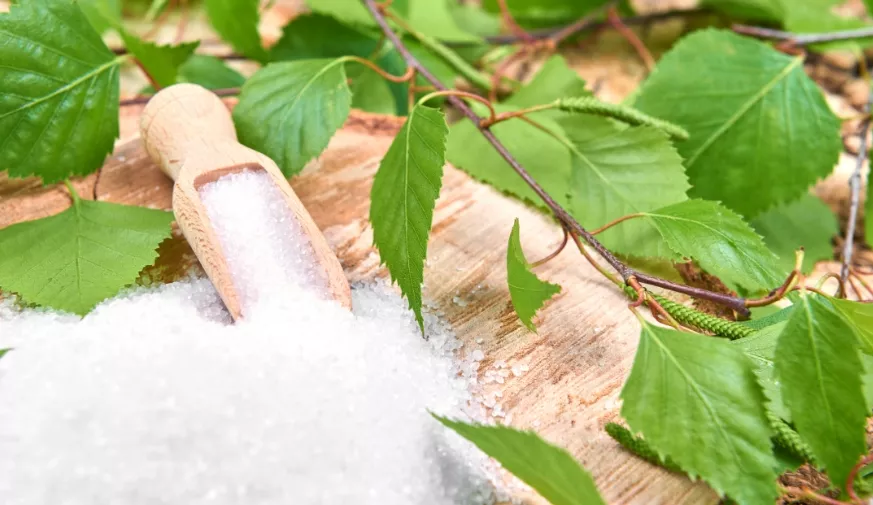
Xylitol (E967) is a sugar alcohol, often referred to as birch sugar. It occurs naturally in small amounts in certain fruits such as strawberries, berries, and plums, but on an industrial scale it is primarily derived from plant biomass. Its sweetness is almost identical to that of table sugar, making it an easy substitute for sucrose in formulations without the need for complex recalculations.
Xylitol dissolves well, which makes it suitable for liquid applications, while its moderate heat resistance may limit its use in prolonged baking processes. From a sensory perspective, it is characterised by a clean, sweet taste very similar to sucrose, without a bitter aftertaste, and may also provide a slight cooling effect.
Similar to stevia, xylitol does not cause a rapid increase in blood glucose levels, which is why it is used in formulations targeted at individuals with insulin resistance, overweight, or diabetes. It is also considered beneficial in reducing the risk of tooth decay, which increases its popularity in functional products, chewing gums, and supplements.
Xylitol is a versatile sugar substitute that combines technological functionality with strong consumer acceptance.
Erythritol – a low-calorie sweetener with a cooling effect
Erythritol (E968) belongs to the group of polyols and is one of the most commonly used sugar substitutes in the food industry. It offers a sweetness level of approximately 60–70% of sucrose, making it suitable for formulations that require a more subtle taste profile and greater control over sweetness intensity.
An additional advantage is its cooling effect, which enhances the freshness of fruit and mint flavours. It is characterised by good solubility and moderate thermal stability.
Its key advantages include low caloric value and a low glycaemic index. For this reason, erythritol is widely used in formulations of diet, functional, and products intended for individuals with metabolic disorders. It also performs well in beverages, toppings, and baked goods processed at lower temperatures.
In practice, it is often combined with other sweeteners to achieve a fuller and more natural sensory profile. From a consumer perspective, it is perceived as a natural sugar substitute, which increases its attractiveness in final product labelling.
Acesulfame K – a high-intensity sweetener with strong thermal stability
Acesulfame K (E950) is a synthetic high-intensity sweetener. It is approximately 200 times sweeter than table sugar. Its energy value is around 0–0.2 kcal/g—so low that it is considered zero-calorie in the food industry. As a result, it is widely used in the production of low-calorie foods and beverages..
Its technological profile is characterised by excellent water solubility, ensuring beverage clarity, as well as high thermal stability and resistance across a wide pH range. This makes it suitable for use in baked goods as well.
From a sensory perspective, acesulfame K may impart a slightly metallic aftertaste. For this reason, it is often combined with other high-intensity sweeteners, such as sucralose, to achieve a more natural sweetness profile and minimise aftertaste.
Sucralose – a sweetener 600 times sweeter than sugar
Sucralose (E955) is a synthetic sweetener characterised by exceptional stability and technological performance. It is up to 600 times sweeter than table sugar and is virtually calorie-free, as it is not metabolised by the body and is largely excreted unchanged.
In production practice, this allows for a significant reduction in the amount of raw material used and helps lower the caloric value of formulations compared to products based on white sugar.
Thanks to its high thermal stability and resistance across a wide pH range, sucralose is widely used in baked goods, beverages, toppings, and products requiring extended shelf life. It dissolves easily, which is particularly important in liquid formulations. Its taste profile is close to that of table sugar, with only a slight aftertaste.
What regulations govern the use of sweeteners in the food industry?
The use of sweeteners in the European Union is strictly regulated by law. The primary framework is Regulation (EC) No 1333/2008, which—under Annex II—defines the permitted sweeteners, both natural and synthetic, along with their maximum usage levels expressed in mg/kg or mg/l.
This is complemented by Commission Regulation (EU) No 231/2012, which establishes specifications and purity criteria for food additives. The European Food Safety Authority (EFSA) sets the Acceptable Daily Intake (ADI) for each substance, supporting safety assessment and risk management.
At a global level, the Codex Alimentarius General Standard for Food Additives (GSFA) helps harmonise usage conditions, facilitating a consistent approach in international food trade.
In addition to legal regulations, manufacturers’ strategies are also influenced by public health policy tools. In many countries, a sugar tax has been introduced to reduce the sugar and sweetener content in beverages and to encourage reformulation.
At the same time, the internationally recognised Nutri-Score system rewards products with a more favourable nutritional profile, including formulations with reduced sugar content.
It is worth noting that, according to research and the position of the Polish Society for Obesity Research, low-calorie sweeteners play an important role in reducing overall sugar intake in the population’s diet. Although excessive consumption of any sweetening substance is subject to limits and may be associated with specific side effects, in the food industry they remain a key tool for product reformulation and for meeting evolving market expectations.
Sugar substitutes – FAQ
Which sweeteners are most commonly used in beverage production?
High-intensity sweeteners such as acesulfame K and sucralose perform best in beverages. They are characterised by high solubility, resistance to pH variations, and stability in carbonated drinks, allowing for maintained clarity and a consistent flavour profile.
Which sugar substitutes work best in dairy and creamy formulations?
In dairy products, a neutral taste profile and no impact on fat structure are essential. In such formulations, erythritol and xylitol are most commonly used, as they blend well with delicate flavours and do not cause undesirable crystallisation.
Which sweeteners are optimal for baking processes?
For baked goods requiring high-temperature processing, stevia and sucralose are primarily used due to their thermal stability. In formulations processed at lower temperatures, such as shortcrust pastries or toppings, erythritol is also commonly applied.
Does the choice of sweetener affect logistics and storage?
Yes—each sweetener has slightly different requirements. Xylitol and erythritol are hygroscopic, so they need protection from moisture. Stevia is stable and does not pose significant storage challenges. Acesulfame K and sucralose are characterised by high durability and resistance, making them easy to store under standard conditions, provided they are protected from moisture and light.
Where to buy sugar substitutes wholesale?
All of the sugar substitutes described above are available in the portfolio of Centro-Chem. We are one of the leading chemical raw materials distributors in Europe. Our operations are certified under ISO 9001, ISO 45001, and HACCP, confirming high standards of quality and safety throughout the entire supply chain.
For a tailored offer, feel free to contact our Sales Department at handel@centro-chem.pl or +48 603 134 003.